
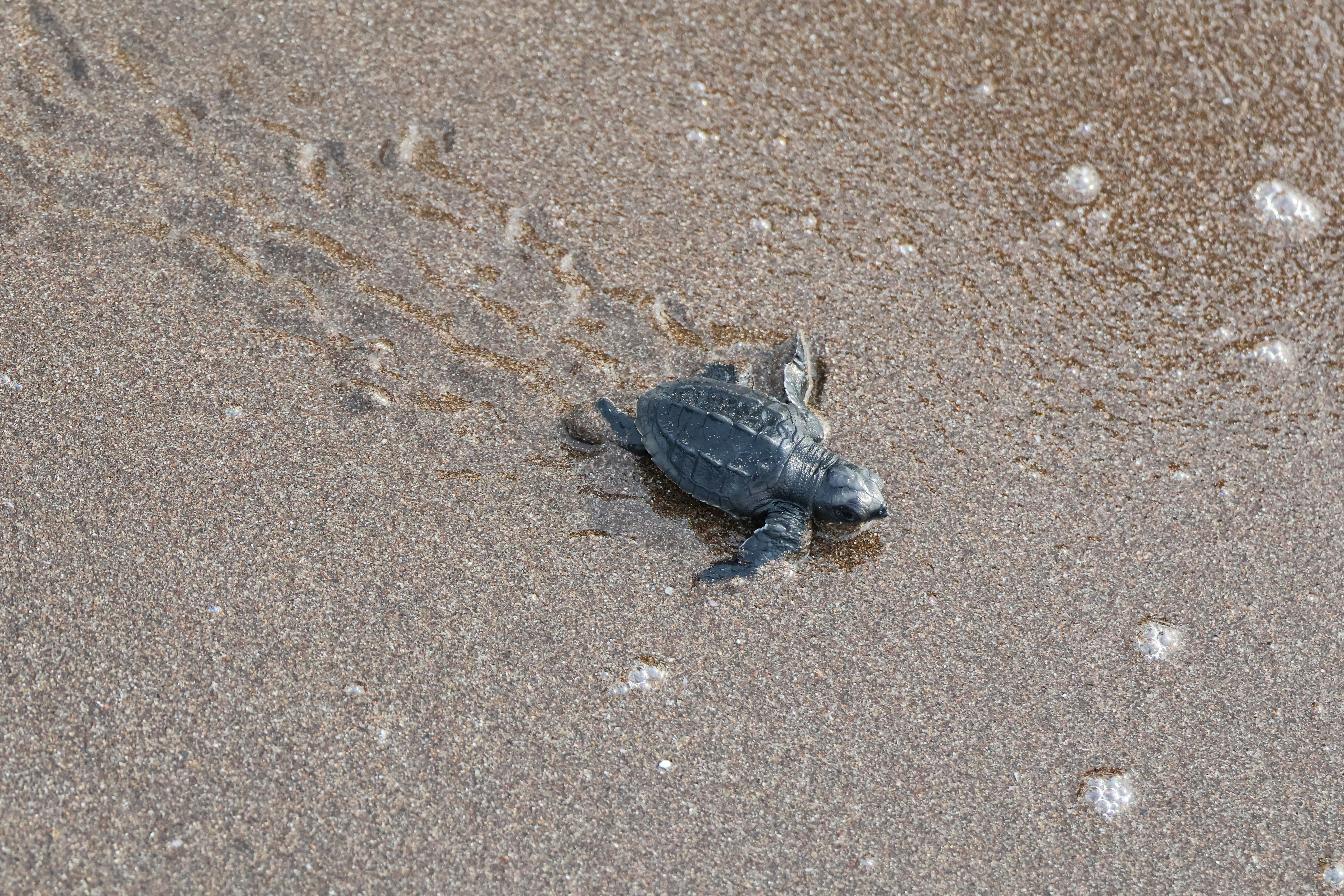
Introduction: Turtles in a City’s Surf
Along the southeastern coast of India, olive ridley sea turtles still crawl out of the Bay of Bengal to nest on beaches that now sit inside the Chennai metropolitan area. Chennai is a city of roughly ten million people, ringed by ports, apartments, and arterial roads, yet each northeast monsoon season females climb ashore at night to dig nests in the same strip of sand that absorbs streetlight, construction debris, and cricket matches. Their presence turns an ordinary urban shoreline into a test case: can a modern city keep enough of a coastal ecosystem intact for an ancient reproductive cycle to continue?
For much of the late twentieth century, the answer looked grim. Olive ridleys across India’s east coast suffered heavy losses from direct harvest and, later, from entanglement in trawl and gill-net fisheries. Mass strandings of adults on Odisha’s beaches and periodic reports of dead turtles along Tamil Nadu’s shore made national news, but hard data on population size and trends were sparse. Conservation on Chennai’s beaches began not with a sweeping plan, but with small groups of students and naturalists walking the sand at night and learning to see nesting as more than an occasional curiosity.
The Bay of Bengal and Chennai’s Shoreline
The turtles nesting near Chennai are part of a larger Bay of Bengal system that links river basins, coastal currents, and heavily used fishing grounds. The western Bay receives sediment and nutrients from major rivers like the Ganges–Brahmaputra–Meghna, Mahanadi, Godavari, Krishna, and Cauvery, creating productive nearshore waters that support dense fisheries and rich food webs. Seasonal monsoon winds and cyclones reshape the coastline frequently, shifting sandbars, eroding some sectors, and building others.
Tamil Nadu’s Coromandel Coast faces directly into this dynamic environment. Historically, low, gently sloping beaches backed by dunes and casuarina or native scrub provided nesting habitat for olive ridleys along tens of kilometers of shore. Offshore, shallow continental-shelf waters in the 10–30 metre depth band supported mixed fisheries for shrimp, demersal fish, and small pelagics. These same shallow grounds are where adult turtles forage on crabs, jellyfish, and other invertebrates between nesting events.
Over the last fifty years, the coastline has been reworked by a combination of hard structures and urban expansion. Ports, breakwaters, and seawalls have altered littoral drift, contributing locally to erosion and accretion. Thermal power plants and industrial complexes have occupied portions of the backshore. Within the city limits, many beaches now back directly onto roads, apartment blocks, and commercial strips, with artificial lighting spilling across the sand. The physical template that nesting turtles evolved to use—a dark, quiet, gently sloping beach buffered by dunes—now persists only in fragments around and between built-up areas.
Before Conservation: Nets, Strandings, and Coastal Change
India has a long history of using marine turtles, but the most intense pressures on olive ridleys along the east coast emerged in the twentieth century. In earlier decades, coastal communities harvested eggs and occasionally adults for meat and oil, but populations persisted at large scales. By the 1970s and 1980s, two changes converged: industrial fishing effort increased sharply in nearshore waters, and coastal development began to squeeze nesting habitat.
Mechanised trawlers and large-mesh gill nets expanded rapidly along the east coast as part of national policies to increase marine fish production. Trawlers operating close to shore dragged heavy nets across turtle feeding and migration corridors, while set and drifting gill nets created nearly invisible walls of mesh in the water column. Turtles that encountered these gears often drowned before they could reach the surface to breathe. At the same time, larger-scale directed harvest and trade in turtles declined after legal protections were introduced, so bycatch became the dominant source of adult mortality.
Odisha’s mass-nesting beaches—Gahirmatha, Devi, and Rushikulya—provided some of the earliest clear signals that bycatch mortality had reached unsustainable levels. In the 1990s and early 2000s, surveys documented thousands of dead olive ridleys washing ashore near these rookeries in some seasons, with carcasses showing signs of net entanglement. Along Tamil Nadu’s coast, including near Chennai, strandings were documented less systematically but followed a similar pattern: clusters of dead turtles appeared during peak fishing seasons, implicating trawl and gill-net fisheries as a major driver of mortality.
Habitat pressures mounted in parallel. Coastal Regulation Zone (CRZ) rules were introduced in the 1990s to restrict construction close to the high tide line, but implementation was uneven. In and around Chennai, sand mining, ad hoc seawalls, roads, and beachfront development narrowed or fragmented the zone of suitable nesting habitat. Dogs, artificial lighting, vehicular traffic, and beach grooming further reduced the quality of remaining sites, especially inside the city.
Early Conservation on Chennai’s Beaches
Against this backdrop, conservation on Chennai’s beaches emerged from civil society rather than from a top-down plan. In the late 1970s and 1980s, local students and naturalists began walking the city’s beaches at night during the nesting season, looking for turtle tracks and nests. Their effort coalesced into what became the Students’ Sea Turtle Conservation Network (SSTCN), which still operates today in partnership with the Tamil Nadu Forest Department.
The basic method was simple but labour-intensive. Patrols covered designated stretches of beach between roughly 23:00 and 04:00 during the nesting season. When volunteers encountered a fresh crawl and nesting site, they assessed its vulnerability: nests laid below the spring-tide line, near bright lights, in heavily trafficked zones, or close to dog paths were flagged for relocation. Eggs from such nests were carefully excavated and moved to fenced hatcheries placed above the high tide line on relatively undisturbed sections of beach.
Hatcheries used low-tech designs: rectangular plots of sand enclosed with fencing to exclude dogs and people, with each clutch reburied at similar depth and spacing to the original nest. Each nest was labelled with date, location, and number of eggs. Volunteers monitored the plots daily, recording emergence dates and counting empty shells after hatching to estimate success. When hatchlings emerged—typically 45–60 days after laying—they were collected, transported in containers to darker stretches of shore, and released at the surf line after dusk.
Over several decades, SSTCN and partner groups report having relocated and released several hundred thousand hatchlings from Chennai and nearby beaches—individuals that, without intervention, would likely have been lost to predation, flooding, or direct disturbance. In parallel, weekend “turtle walks” and school visits to hatcheries raised public awareness. Media coverage turned olive ridleys into a recognized part of Chennai’s coastal identity, shifting the baseline from “turtles as rare curiosities” to “turtles as seasonal residents whose presence carries obligations.”
These beach-based efforts did not directly address offshore bycatch or structural coastal change, but they established two foundations: a cadre of trained local volunteers and long-term, site-specific knowledge of nesting patterns on an urban shore.
National Bycatch Concerns and Policy Responses
As strandings data and field observations accumulated from Odisha, Andhra Pradesh, and Tamil Nadu, scientists and advocates began to quantify bycatch in India’s east-coast fisheries more systematically. Studies using onboard observers, port sampling, and fisher interviews in the 1990s and 2000s estimated that thousands of olive ridleys were dying each year in trawl and gill-net fisheries along the Bay of Bengal coast, especially near major nesting areas.
Legal protection for turtles themselves was already in place: olive ridleys were listed under Schedule I of India’s Wildlife (Protection) Act by the early 1990s, making killing or trade an offence. Coastal Regulation Zone notifications created nominal buffers against destructive coastal development. However, laws aimed specifically at reducing fishery bycatch lagged behind the scale of the problem.
India introduced regulations requiring Turtle Excluder Devices (TEDs) on certain shrimp trawlers in the 1990s, in part responding to international pressure and trade concerns. A TED is a metal grid installed inside a trawl net that allows smaller target species like shrimp to pass through while deflecting larger animals—such as sea turtles—toward an escape opening in the netting. Laboratory and field tests indicate that properly installed TEDs can prevent the vast majority of turtle captures while retaining most of the shrimp catch.
In practice, compliance along India’s east coast has been uneven. Many trawler owners and crews have resisted TED adoption, fearing loss of shrimp and facing limited enforcement capacity at sea. Small-scale and mechanised gill-net fleets, which account for a large share of turtle bycatch in some regions, are not directly addressed by TED rules. Seasonal fishing bans and no-trawl zones near key rookeries have been implemented in Odisha and, more recently, extended or proposed in other states, but enforcement remains variable.
Court cases and public-interest litigation have occasionally forced state agencies to respond to mass mortality events, for example by ordering stricter enforcement against illegal trawling in nearshore waters or by scrutinizing sand mining and port projects near nesting beaches. These legal interventions have created episodic windows of tighter control but have not yet delivered consistently low bycatch along the entire east coast.
Monitoring, Telemetry, and Recent Trends
Until recently, assessments of whether these conservation measures were working relied on incomplete data: local nest counts, sporadic strandings reports, and limited fishery bycatch studies. Over the last 15–20 years, several initiatives have improved the picture.
A multi-site program coordinated by Dakshin Foundation and partners has compiled long-term nesting and strandings data from monitoring sites across India’s coast from 2008 to 2024. At Odisha’s Rushikulya rookery, nest counts increased from roughly 25,000–50,000 nests per season in the early 2000s to over 150,000 nests per season in the past decade, with some years estimating more than 400,000 nesting females. These numbers suggest that, where beach protection and seasonal fishery restrictions are reasonably enforced, olive ridley nesting can stabilise or rebound from earlier lows.
Nationwide assessments synthesize these site-level data with historical records to argue that India’s olive ridley populations, particularly in the northeast Indian Ocean management unit, are now better off than conservationists feared two decades ago—though still exposed to substantial bycatch and emerging climate risks. Experts caution that robust population estimates are complicated by factors such as variable remigration intervals and uncertainty about how many nests each female lays per season.
In Tamil Nadu, including around Chennai, monitoring has been more fragmented but is improving. The state’s wildlife authorities and NGOs have begun standardizing beach patrol data, documenting nesting at multiple sites along the Coromandel Coast rather than only at iconic locations. In 2025, Tamil Nadu announced a two-year telemetry study to tag and track 20 olive ridley females from key nesting beaches, including near Chennai. Satellite tags and large-scale flipper-tagging (10,000 tags for approximately 5,000 turtles) are intended to map post-nesting migration routes, identify nearshore foraging hotspots, and quantify overlap with fishing effort.
Early results from the 2025–26 nesting season are mixed but instructive. Chennai’s beaches recorded over 100 nests in the first 40 days of the season, reportedly the fastest pace in roughly three decades. At the same time, at least one of the newly tagged turtles washed ashore dead, entangled in a fishing net inside a restricted zone, and observers documented mechanised trawlers operating in nearshore waters where regulations prohibit them during nesting season.
Evaluating Conservation Outcomes on an Urban Coast
Taken together, the available evidence points to a nuanced conclusion. At the scale of India’s east coast, turtle protection laws, seasonal fishing bans near major rookeries, and localized enforcement have likely reduced adult mortality from its peak and allowed important nesting aggregations—especially in Odisha—to recover from dangerously low levels. Long-term monitoring data support the view that, in some places, conservation has changed the trajectory of olive ridleys.
On Chennai’s urban beaches, conservation has clearly changed the story, even if it has not changed the ending. Sustained night patrols, nest relocations, and hatchery releases have kept nesting activity alive on stretches of shoreline that might otherwise have lost turtles entirely to dogs, flooding, and disturbance. Public awareness is markedly higher than it was in the 1980s; olive ridleys are now part of Chennai’s civic narrative rather than an obscure biological detail.
However, several constraints remain. First, Chennai and much of Tamil Nadu’s coast lack the kind of long, continuous, dark beaches that anchor global-scale rookeries. This limits how large local nesting numbers can become, even under ideal management. Second, offshore bycatch in trawl and gill-net fisheries remains a significant, largely unquantified source of mortality for turtles using Tamil Nadu’s nearshore waters. TED regulations and seasonal closures exist on paper but are inconsistently implemented, and they do not fully address bycatch from non-trawl gears.
Third, coastal development and climate change are remaking the physical nesting environment. Hard-engineered structures, altered sediment budgets, and sea-level rise are shifting beach profiles and flood risk in ways that may erode or submerge remaining suitable sites. Artificial lighting, vehicle traffic, and dogs continue to affect nest success and hatchling orientation on many urban and peri-urban beaches.
In this context, conservation success on Chennai’s coast cannot be measured solely by nest counts or hatchling releases. A more realistic yardstick is whether the city and state can maintain a network of functional nesting sites and relatively safe corridors through nearshore fishing grounds over coming decades, despite growth and climate pressures. That implies at least four continuing priorities:
1. **Strengthening and stabilising beach protection** on key nesting stretches, including enforcing CRZ rules, controlling lighting, limiting vehicle access, and accommodating shoreline migration as sea level rises. 2. **Improving fishery bycatch management** by increasing compliance with TED regulations where they apply, developing and testing bycatch-reduction measures for gill nets, and expanding observer and monitoring programs in nearshore fleets. 3. **Scaling and integrating monitoring** so that nest counts, strandings data, and telemetry results feed into adaptive management at state and national levels rather than remaining isolated projects. 4. **Deepening fisher engagement** to align conservation with viable livelihoods, recognizing that many bycatch decisions are made under tight economic and regulatory constraints.
Conclusion
Olive ridley turtles have existed as a distinct lineage for millions of years, and sea turtles as a group for roughly 100 million years. Modern humans (*Homo sapiens*) have been around for approximately 300,000 years. On Chennai’s beaches, these timescales intersect in a narrow, heavily used strip of sand where a city’s rules and an ancient migratory program now overlap.
The available data suggest that conservation along India’s east coast has already prevented worse outcomes for olive ridleys, and in some rookeries enabled genuine recovery. On Chennai’s coast, conservation has shifted the odds for nests and hatchlings and begun to map and manage at-sea risks. Yet the system remains finely balanced. Continued progress will depend less on any single intervention and more on whether beach management, fishery regulations, coastal planning, and public engagement can be maintained and adapted over time in an urbanising, warming world.
If that happens—if enough dark sand remains above the high tide line, and enough turtles can move through nearshore fisheries without drowning—then the olive ridleys nesting at the edge of Chennai may continue to anchor a form of wildness that is compatible with, rather than erased by, a busy coastal city.
How this site works
We focus on verifiable outcomes and link to primary sources whenever possible. If you spot an error, we want to fix it.